Projects & Activities
Since its establishment, HEAŞ has provided a full range of services—from Terminal Operations to Air Traffic Control Tower services, from Ramp Services to Cargo Terminal Management. As of 2008, HEAŞ assumed the responsibility of the Airport Authority and began executing these activities together with its stakeholders.
To anticipate rapid developments in aviation and plan investments accurately, HEAŞ collaborated with ARUP, one of the sector’s leading international firms, on Masterplan studies to create a roadmap and growth strategies for the airport’s development. This approach enabled the timely implementation of targeted investments in response to increasing passenger and aircraft traffic.
Additional Apron and Ancillary Facilities
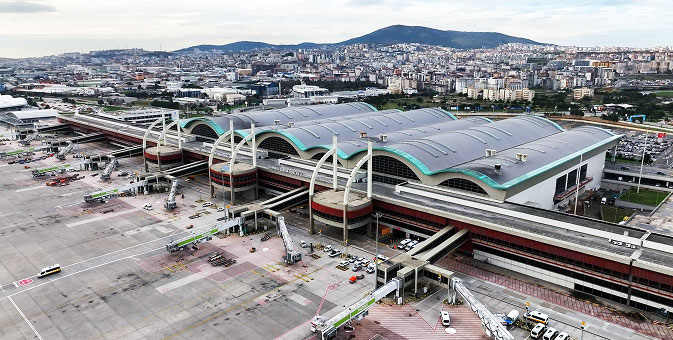
With the growth of the aviation sector and the increasing demand from both airlines and passengers at Sabiha Gökçen Airport, passenger statistics in 2010 reached approximately 1.5 times the projected figures. As a result, the development projects for the PAT (Runway, Apron, Taxiway) areas specified in the Masterplan were rapidly implemented. To address construction challenges and plan financial resources, feasibility and preliminary design studies for the Second Runway project were initiated with ARUP in 2010. While the Second Runway project was ongoing, HEAŞ simultaneously began infrastructure investments for the PAT areas. The Additional Apron and its annexes project, designed to serve a total of 19 narrow-body (Code C) aircraft, was rapidly implemented. As a result, the passenger apron capacity, previously 48 aircraft, increased to 67 aircraft, marking a 40% increase in parking capacity.
General Aviation Hangars
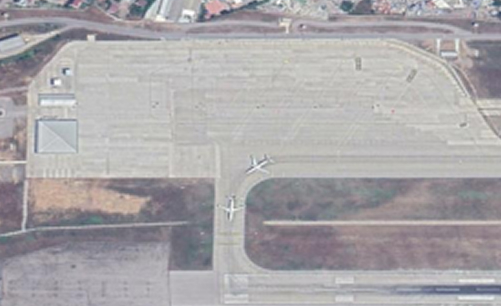
De-Icing Apron and Ancillary Facilities
To carry out de-icing operations from a single location during harsh winter conditions without reducing our existing parking capacity, and to enable aircraft to reach the runway quickly, a 115,000 m² paved area was constructed at the heavily used Runway 06 threshold, completing the De-Icing Apron and its ancillary facilities.
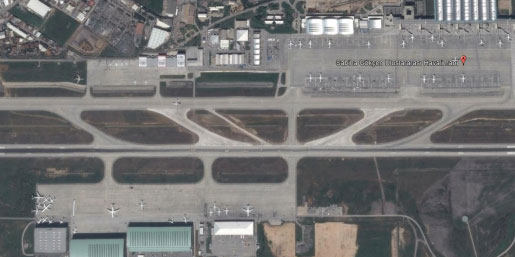
Rapid Exit Taxiways
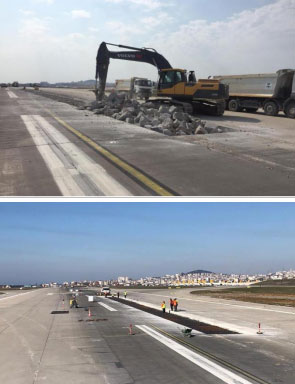
Runway Maintenance & Repair
Following the opening of the second runway, while planning to close the existing runway for maintenance and repair activities, these works had to be brought forward due to increased traffic. Therefore, under heavy traffic conditions, all risks were carefully assessed, and using advanced construction techniques and R&D-developed specialized materials, the runway was largely renewed during five-hour nightly closures, ensuring that operations could continue more comfortably and safely.
The works were showcased during the “Rapid Concrete Night” event, hosted with 50 participants from 10 countries. During the global COVID-19 period, our airport remained closed for only 25 days, and all construction activities that would have posed risks during flight operations were completed within this short closure period. As a result, according to the European Airports Council (ACI Europe), Sabiha Gökçen Airport was awarded the Highly Commended Airport recognition in the category of airports handling 25–40 million passengers.
Co-Generation (Co-Gen) Plant
As a result of efforts on sustainable energy sources, a Co-Generation (Co-Gen) Plant has been established at our airport. With the commissioning of the facility, an environmentally friendly alternative for energy supply has been provided.
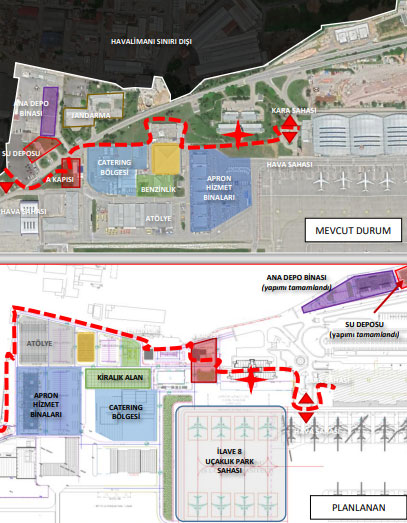
Northern Airspace Development
The Northern Airspace Development Project is a growth initiative aimed at meeting the increasing airside space requirements based on the current operational needs of our airport. To date, the project has been completed with the construction and commissioning of the Water Tank and Main Depot Building.
Airport City
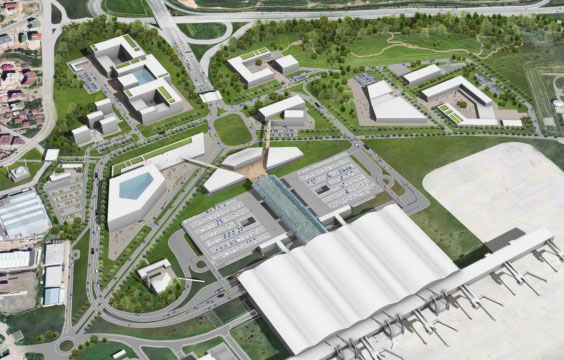
All of our airport investment plans are carried out in line with the Masterplan. Accordingly, in 2018, the Masterplan was updated to schedule how and when new investments would be implemented based on increases in passenger capacity. In addition to the Masterplan, work has begun on the AIRPORT CITY project, aimed at introducing new functions on the landside to create an attractive hub and indirectly contribute to passenger traffic. The project includes facilities such as healthcare centers, hotels, and conference halls that can be integrated with the terminal, providing added value not only to our airport but also to the country, supporting further growth.
Terminal III
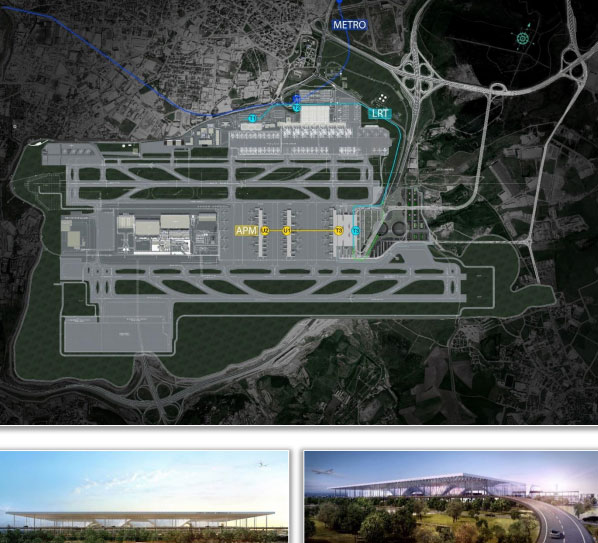
With the decision to construct the second runway, terminal expansion strategies were developed in parallel with the increased airside capacity. A design competition was held for the construction of Terminal III, inviting five architectural firms with international experience in terminal design and construction. As a result of the competition, the design by Tabanlıoğlu Architecture was selected as the most modern, environmentally friendly, and sustainable project, and Sabiha Gökçen Airport earned the right to be the Project Author for Terminal III and its ancillary facilities. Once the project is completed, the Main Terminal Building will serve 25 million passengers per year, and with the construction of the Satellite Gates, the capacity will increase to 35 million passengers per year. Additionally, with further expansions of the Main Terminal Building, capacity can reach 41 million passengers per year. Upon completion of all planned investments, Sabiha Gökçen Airport will have the potential to serve up to 80 million passengers per year at maximum capacity.
Rail System
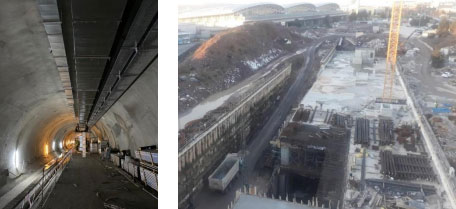
Our airport, which serves Istanbul’s domestic and international air transportation, will be connected to the Kadıköy–Kartal–Kaynarca metro line via a rail system, providing passengers with safe, punctual, and economical access to the airport. The construction and electromechanical system supply, installation, and commissioning works for the Sabiha Gökçen Airport Rail System Connection, tendered by the General Directorate of Infrastructure Investments (AYGM), are being carried out by the Gülermak-YSE joint venture.
Second Runway and Ancillary Facilities
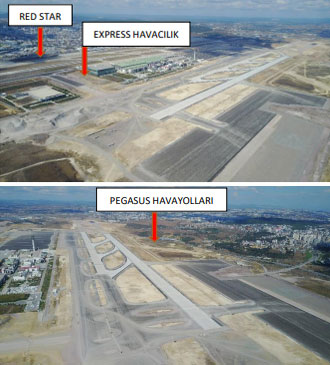
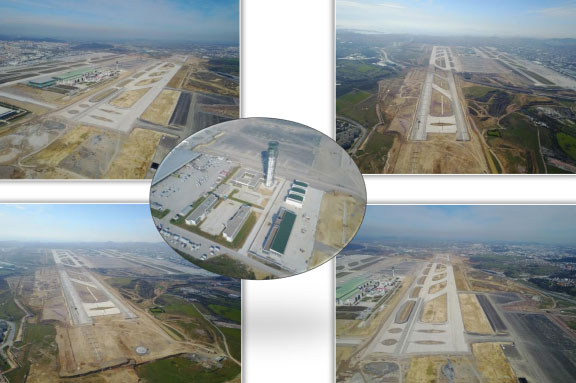
Due to its location, our airport has become a key transportation hub for the Anatolian side and nearby cities. As the airport grew beyond the capacity of a single runway, the second runway project—allowing simultaneous operations—is being commissioned by the Presidency of Defence Industries. The project is being executed by the General Directorate of State Airports Authority (DHMİ) and is expected to become operational within 2023.